

I Underestimated Myself
“We know what we are, but know not what we may be.” - William Shakespeare
Week 22 — 05-31-26
Sober since May 26, 2025 — Day 371 (one year sober, as of this post)
I knew it was bad before the judge said it.
I just wasn’t ready to admit how bad. I still had explanations, plans, and a version of the story where I was almost in control. Drinking had shifted from something I did to something I spent most of my energy explaining.
It started in places where I could make it sound normal: weekends, parties, college. Then the line moved. Then it moved again. Eventually, I had moved it so many times that I could barely remember where it started.
I could explain almost anything back then. That was part of the problem. I could make consequences sound complicated. I could make concern sound like an overreaction. I could make my own panic sound like a plan. I could dress myself up, walk into a room, speak clearly enough, and hope no one looked too closely at the parts of me that were coming apart.
The morning I went to court, I put on a dress shirt, a tie, and shoes that made me look more put together than I was. It wasn’t even one of the nice outfits I used to wear for work. Most of that was in storage by then, so this was more of a Walmart special. That was the costume: a man trying to look like he still had control over a story that had already gotten away from him.
By the time I stood in front of the judge, I wasn’t a man asking to be misunderstood. I was a man running out of ways to make the truth sound less true.
The judge said something along the lines of, “I think you have a problem, and I don’t think you’re able to stop.” I don’t remember every word exactly. I remember standing there in my tie, still wanting one more person to believe the version I was trying to present. Somewhere beneath the fear and humiliation, I understood he wasn’t wrong.
He told me he was putting me in jail because he believed it was the only way to keep me alive. That is a brutal thing to hear when part of you still wants to believe you’re being judged too harshly and another part of you knows the sentence might be true.
I took off my tie. I took off my watch. I emptied my pockets. I handed my wallet and phone to my lawyer so he could give them to my mom. Then they took me away in handcuffs.
I wish I could say something changed in me right then. It didn’t. I was scared, humiliated, angry, and cornered by the simple fact that there was nobody left to blame who could make the moment disappear.
Then jail became noise before it became anything else.
People yelling and losing their minds. People were trying to fight officers and making sounds I had only heard from people who were far past caring how they sounded. I sat in a holding cell for hours in my court clothes, waiting to find out what came next. Time didn’t feel right in there; it stretched, stopped, and folded back on itself. Minutes felt like hours, hours felt like days.
I had gone to court dressed for court, not for jail. I hadn’t packed for the life I was entering. They took my socks, my underwear, my clothes, everything except the white undershirt I had on under my dress shirt. Jail has rules about clothing, and if it isn’t all white, you may not get to keep it. The explanation was simple. The feeling was harder to explain. They gave me stripes, bright orange slides, and a mattress to carry. That was about it.
When they finally put me in the pod, the first thing I saw was a man lying on the floor in his own vomit. He was dope sick. Shaking. Clinging to whatever was left of himself. There was nothing cinematic about it. He was a real man on a real floor, sick in a way that made the body look like it was trying to escape itself. I never saw him again. I don’t know what happened to him.
I looked at him and thought, that is what is waiting for me.
Not because our stories were the same. I didn’t know his name or what brought him there. But I recognized the direction. I knew what it looked like when the thing you kept feeding finally started eating you back. That image didn’t feel like a lesson. It felt like a warning with no mercy in it.
I kept my head down and stayed quiet. I tried to learn the rhythm of a place I didn’t want to belong to, but there wasn’t much rhythm to learn. There were no clocks I could see. The lights stayed on all day and all night. I didn’t sleep the entire time I was there. Time became meals, counts, and noise. Breakfast around four in the morning, lunch at noon, dinner around four. Count, noise, movement, someone yelling, someone pacing. I could only tell what day of the week it was by getting woken up by the guards around 2 AM for laundry and cell shakedowns. Tuesdays, Thursdays, and Saturdays.
I spent most of the time detoxing and hallucinating, lying on the bunk watching the concrete floor move like waves. When I closed my eyes, I saw all sorts of things. My body was shaking, sweating, racing, and somehow exhausted at the same time. My mind kept slipping in and out of places I couldn’t explain. It was a living hell, and I was trying to act normal in a place where nothing felt normal. Alcohol is one of those things people can die from coming off of, and I knew enough to be scared. I didn’t know if I was going to have a seizure, lose my mind completely, or just keep lying there while my body tore itself apart. I wanted to throw up, but I hadn’t eaten enough. I wanted to shower, but I didn’t have soap, a towel, or the courage to do it. I wanted to sleep, but the lights and the noise and whatever was happening inside me wouldn’t let me rest.
There wasn’t much to do in there except sit with yourself, and I wasn’t exactly good company yet. There were no books to read. I asked for a Bible, but I wasn’t able to get one until the day I left. Still, I don’t believe I was alone in that cell. I didn’t have clean language for it yet, and I wasn’t walking around sounding holy, but I believe God was with me in there. At some point, I started wanting paper. Not in some dramatic way. I just needed somewhere to put what was happening in my head.
After a few days, someone gave me two little packets of soap for my “cake” from my lunch tray. They looked like ketchup packets. I used one to finally shower. I traded the other for a makeshift pen and a couple of pieces of paper.
I was in jail, sick, scared, humiliated, and stripped down to almost nothing. I needed every small comfort I could get, but I still traded one of them for a way to write. I wrote in my cell on the little metal stool, under bad fluorescent lighting, with a pen I wasn’t sure I was supposed to have. People didn’t write in jail, at least not where I was. They played cards, talked, slept, paced, fought, or just tried to get through the hours. Writing felt strange and exposed in there, but I wrote anyway.
It wasn’t about talent or ambition. It was survival. In jail, writing stopped being something I liked and became something I needed. It was one of the only ways I still felt attached to myself when everything else had been stripped away.
Eventually, I got out. I was out long enough to go to a graduation party for someone I care about before going to rehab. Jail, then a graduation party, then rehab. My life wasn’t moving in clean emotional order. It moved the way consequences move: hard things beside tender things beside necessary things.
While I was locked up, my family was trying to figure out how to reach me, what I needed, and how to pack for a place I hadn’t even arrived at yet. Addiction doesn’t just punish the person drinking. It spreads fear into the people who love you. I don’t say that to punish myself forever. I say it because I don’t want to lie about the cost.
When I got to rehab, my bags were already there. My mom and sister had packed them with care. Some things weren’t allowed because of the rules, but inside was a notebook and a pen. I had traded soap for paper and a pen in jail. Then I got to rehab and found a notebook waiting for me.
I’m careful not to force meaning onto every detail, but I can’t pretend that it didn’t matter. At the lowest point, writing kept helping me stay attached to myself.
Rehab gave the days structure. No phone or television. Nowhere familiar to hide. My mind was still clearing from years of numbing, explaining, and avoiding. Honest language felt foreign at first. So I wrote every day, sometimes more than once. I wrote what happened, what I felt, and what I wanted the next day to look like. The page didn’t need me to be impressive. It only asked me to be honest.
After about a week, my case manager saw me writing in the corner and asked what I was doing. I told her, “Nothing.” That’s what I always say when someone catches me doing something private. Nothing. A way to close the door before anyone can look too closely.
She didn’t let me bullshit her.
I was writing. Maybe I tried to hide it because it still felt private. Maybe because telling the truth felt dangerous after spending so long hiding inside lies and half-answers. Secrets had helped get me there. I didn’t need to keep protecting them.
She read some of what I wrote. After that, every couple of days or so, she would ask to read more. She didn’t have to do that. It wasn’t her job. But she could tell the writing was doing something for me before I knew how to explain it, and that mattered.
The rest of the first year was mostly repetition, not revelation. Treatment, outpatient, therapy, meetings, church, work. Another day, another sober hour. Most days, it was doing the next right thing while carrying the same body, the same past, and the same unfinished life.
That was one of the first things recovery taught me: you can’t think your way into a different life while continuing to live the old one. I had always been good at explanations and plans, but a plan is not a practice. Wanting to change is not the same as becoming someone trustworthy when nobody is watching.
Sobriety didn’t magically fix my life. Court, probation, money stress, family complications, old memories, and my own habits were still there. The difference was that I had to meet them sober. At first, that felt less like hope and more like being trapped with the truth. Over time, the truth became a place I could stand.
I learned that discomfort doesn’t have to become destruction. A bad day doesn’t have to become a ruined life.
Help came from many directions: treatment, therapy, meetings, family, faith, and writing. But none of it could live my life for me. That was humbling. I had to learn that God could be with me without doing the work for me. There was dignity in keeping my own word long enough that it started to mean something again.
Somewhere in the middle of it all, writing grew beyond helping me survive my own head. I started Soberman Sundays because I remembered what other people’s stories did for me when I needed proof that a person could be a wreck and still not be finished.
I’m also moving toward recovery work now. I’ve finished the training for peer recovery support and CDCA work, and I’m waiting on the state for the next step. Not because I’m fixed or because I think I have this recovery thing figured out, but because I remember the people who sat with me before I had the right words.
I once wrote a poem about my house being on fire. In it, I’m standing in the only room where the sprinklers still work. Water falls. Not enough to put the whole fire out, but enough to keep me standing in the heat.
That image is closer to the truth than pretending I’m peaceful now. I’m steadier. The fire still flares sometimes: pressure, memories, vigilance, fear. But I have water now: sobriety, therapy, meetings, coping skills, prayer, service, faith, and ordinary structure. None of it makes me untouchable. It just keeps me from burning the house down.
That is what one year sober actually looks like for me.
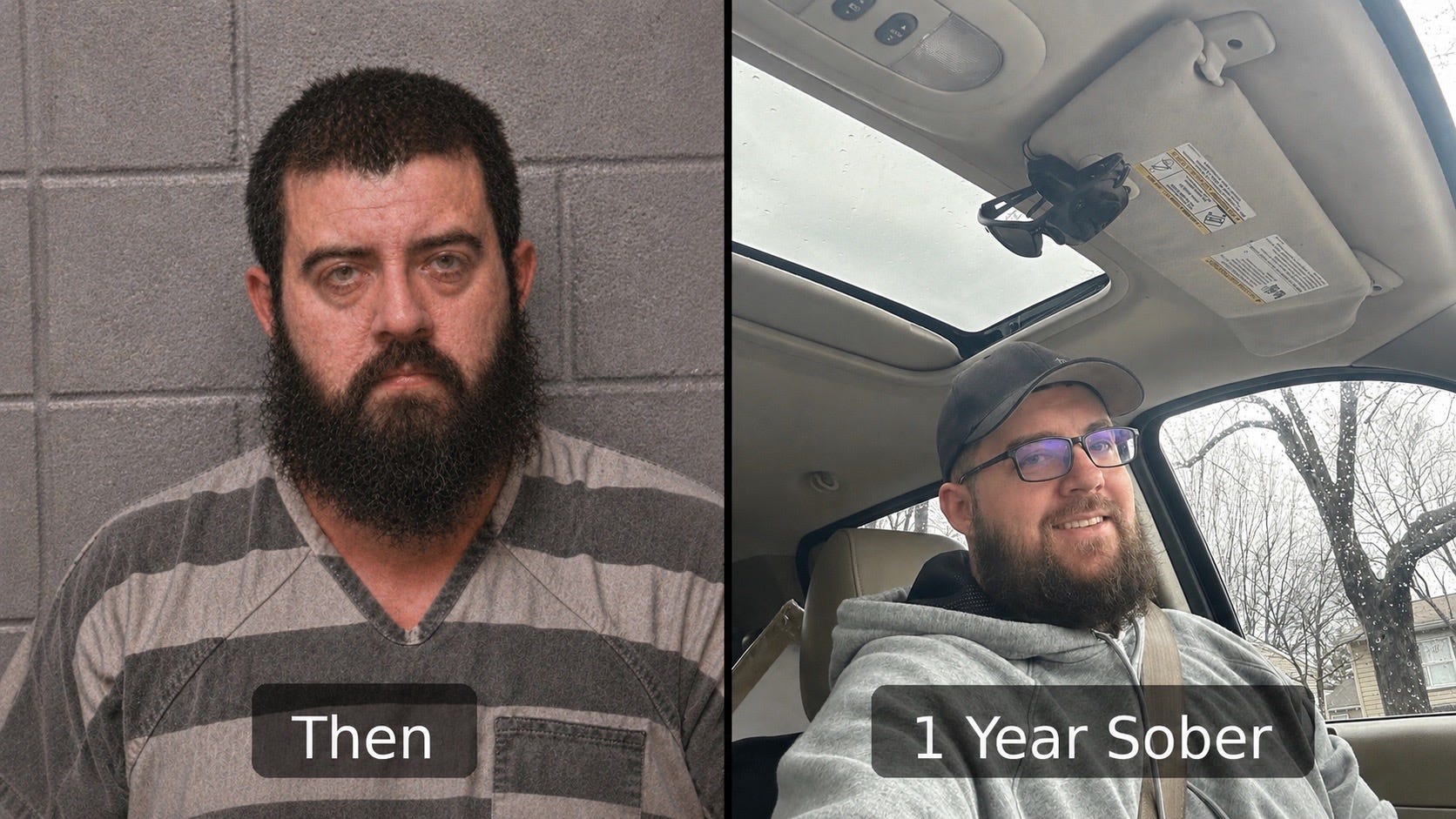
One year sober didn’t erase the evidence against me. The arrest, the jail cell, the mugshot, the broken promises, the people I scared and hurt. All of it is still real. Sobriety didn’t delete the past or earn me automatic forgiveness. It gave me a way to stop adding to the wreckage. Then it handed me a shovel and made me start cleaning up the mess.
This year gave me new evidence instead.
I stayed sober. I showed up when it felt repetitive and pointless. I learned to ask for help before isolation turned destructive. I became more reachable to my family. I found work that fit around outpatient and the life I was trying to rebuild. I learned a new trade and started my own small business. None of that made me instantly stable, but it gave me responsibility that belonged to the man I was becoming.
Ordinary moments still feel quietly profound sometimes: sitting at a table and actually being present, having work to answer for, letting someone care about me without immediately looking for a way to ruin it before it can hurt me. There is someone in my life now who has helped pull me back out into the world in ways I didn’t know I still needed. Her story isn’t mine to tell, but it matters to be sober enough to receive something good.
That doesn’t mean every day feels hopeful. Some days are still heavy. Some days I feel behind. Some days I have to strengthen the same structures that helped keep me sober. But even that is different now. Even a bad day can stay contained.
I’m not where I was.
A year ago, a judge looked at the evidence and didn’t believe I could stop. I understand why. I had given the world plenty of reasons to doubt me. I had given myself plenty of reasons, too. For one year, with a lot of help and imperfect effort, I lived a different answer.
It isn’t a full circle. The story isn’t neat or finished. There are still things I carry. Maybe it’s half a circle: enough distance to see where I started without being trapped inside it. Enough movement to know I’m not the same man who stood in that courtroom. Enough proof to believe another year is possible.
I underestimated myself.
Not because I was secretly strong the whole time. Nothing about this was easy. I underestimated myself because I had never given myself a full year of honest chances. Only excuses, dramatic plans, and short-lived restarts. Now I have.
The man in the mugshot was real. The man in court was real. The man who traded soap for a pen was real, too. I think about him the most. He had almost nothing left, and something in him still reached for words.
That small reach was the first quiet piece of hope. One year later, I’m still reaching. I’m sober, I’m writing, I’m still repairing, and I’m still learning how to become a man I can answer for. I want to see what another year can become.
Congratulations on your 1-year anniversary!!